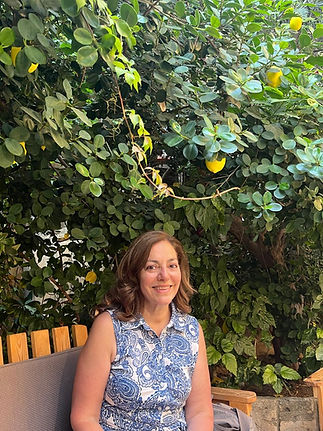
Marie-Therese Hocott,
LPC
Marie-Therese Hocott earned her M.Ed. and C.A.G.S. (Certificate of Advanced Graduate Studies) in Mental Health Counseling and School Guidance Counseling from the University of Massachusetts, Amherst. She holds a license to practice in the State of Michigan as a professional counselor (LPC), and was previously licensed as a School Guidance Counselor (K-12). She also is trained and has worked as a Parent Educator through the First Steps program in Washtenaw County. Her interest in grief counseling compelled her to work toward and receive a degree in grief counseling (GC) from The American Academy of Grief Counseling. Marie-Therese works with families and adults of all ages. Her knowledge of various theories enables her to offer a flexible and
customized approach that suits the specific needs and preferences of each client. She is fluent in English, Arabic and French. Marie-Therese met her future husband, Dr. Gregory Hocott at the University of Massachusetts. They have 2 children and have resided in Ann Arbor since 1998.
Excerpts from an Interview
Q. How do you find meaning in your work?
A. I believe that I am answering a higher call, and that I have been given grace, experience and knowledge to help others heal and become whole. I count it a privilege and an honor to accompany people on their journey of self knowledge, integration, meaning-making and healing.
Q. Where do you find the strength to deal with other people's pain and suffering you encounter daily?
A. My strength comes first from my faith. I strive to maintain inner peace through faith, and in balancing family responsibilities, work and leisure. Volunteering at a nursing home is very rewarding, and it helps to keep perspective on life. I also have supportive and loving relationships that ground me of which my marriage is of utmost importance.
Q. How do you integrate the science of psychology with Christian values as a therapist at the Family Counseling Center?
A. The many theories we explore and learn in psychology form a mosaic that paints a picture of how the mind works, and answers many questions about the person as a social being. That mosaic is illumined within the larger context of Creation and the purpose of life. Christianity addresses aspects of life that psychology cannot or does not address. I read a psychology book on grief once that talks about giving hope to a terminally ill patient. It mentions how one can find hope in every moment up to the moment of death: hope that one will be pain free for 5 minutes, hope that one can be with a family member as one dies- and other such beautiful practical illustrations of hope. Then the authors state that death is not something they wish to address, and the message of hope stops there. Here is where Christianity, or any religion for that matter, can supply much needed hope and continue where psychology leaves off. This is but one simple illustration...
Q. What do you say to clients who are not Christian who seek services from you?
I have worked with many non-Christians over the years. I respect each person as a gift from God and work within the framework of the culture, traditions, religion and values of my clients.